Why Culture, Capability, and Change Still Decide Whether AI Pays Off
This article continues The CX Factor series, exploring the barriers that keep AI from scaling and how CX leaders can turn readiness into measurable results.
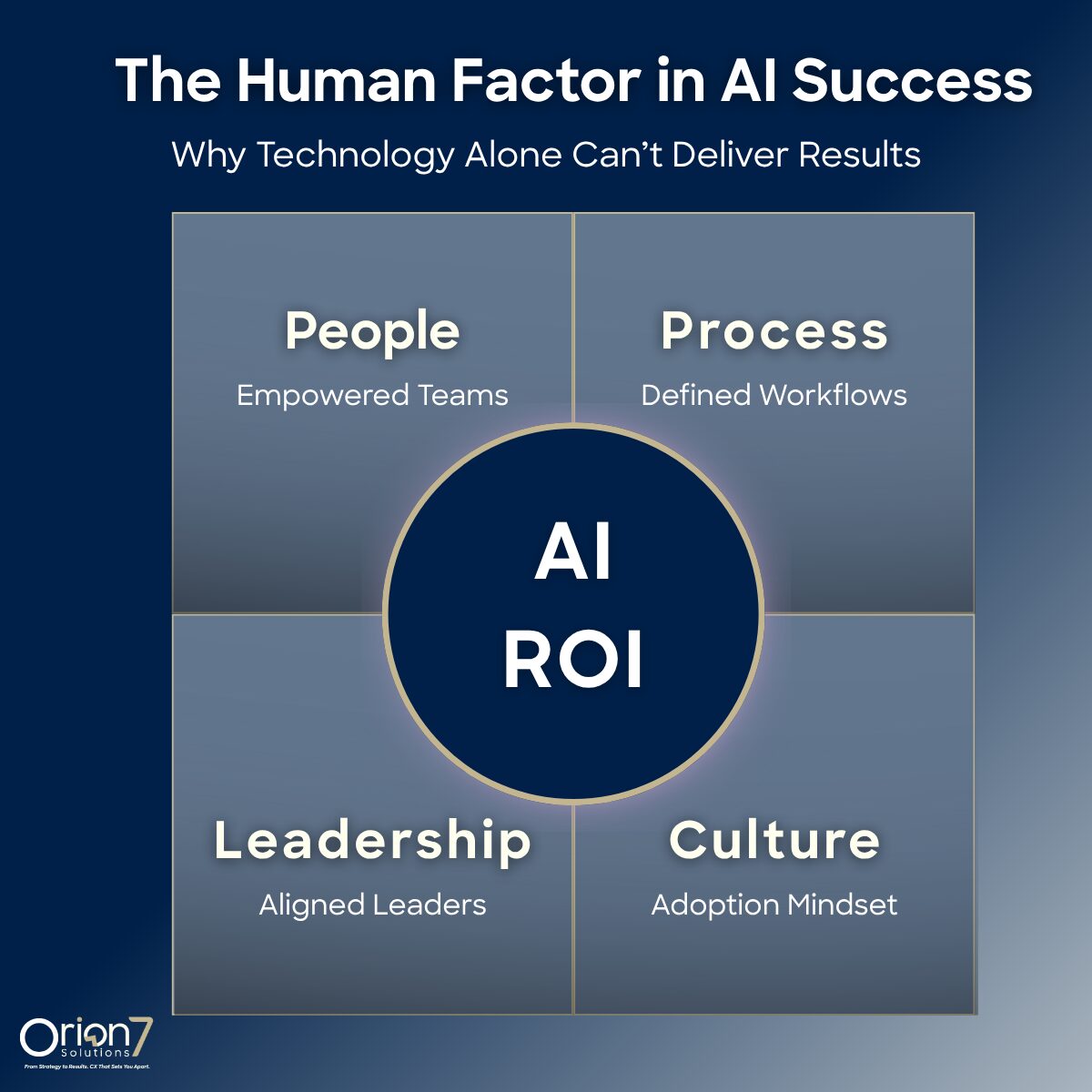
AI isn’t failing because the technology doesn’t work. It’s failing because organizations overlook the human factor in AI success, the alignment of people, processes, and purpose that enables AI to deliver measurable results.
McKinsey’s 2024 survey shows 72% have piloted AI, but only 23% have scaled. Gartner finds nearly half of pilots never move past proof-of-concept. Organizations consistently fail to align strategy, people, and process to produce measurable outcomes.
Employees lack training. Managers don’t trust outputs. Executives struggle to align on ownership. The result is predictable: millions invested, little measurable return.
PwC found that 61% of CEOs worry their teams “lack the skills to effectively use AI,” and only a third have formal programs to address this issue. That gap shows up directly on the balance sheet through lost productivity, underused licenses, and stalled transformation.
According to Deloitte, organizations that pair AI strategy with structured change management achieve 40% higher adoption rates within the first year.
The reality is simple: technical capability means nothing without human readiness.
1. The Hidden Cost of Unready Teams in AI Adoption
When AI projects stall, the losses rarely show up as a single line item. They hide in:
• Productivity drops during rollout
• Duplicated work across old and new systems
• Missed automation opportunities
• Delayed decision cycles while people wait for clarity
Each friction point compounds over time. A $2 million AI investment sitting 60% idle costs $1.2 million in unrealized value every year.
Across the market, a consistent pattern emerges: AI doesn’t fail in IT; it fails in operations when adoption lags. The answer isn’t more dashboards; it’s enablement and structured change management that teams can actually use.
When teams lack readiness, AI’s promise stalls. This is where the human factor in AI success becomes most visible, as every missed connection between people and process slows ROI.
For more on how hidden costs and risks derail AI adoption, explore our analyses on the Hidden Costs of AI Implementation and the Hidden Risks of AI.
2. Leadership Alignment: The Multiplier for AI ROI
The difference between AI that scales and AI that stalls usually comes down to leadership clarity.
Ask three questions:
1. Is there a shared vision for where AI fits into your customer experience strategy?
2. Have you redefined success metrics to reflect new workflows?
3. Are managers incentivized to coach adoption rather than police compliance?
Organizations that answer “yes” to all three achieve two to three times faster time-to-value from AI investments.
We measure this through proven performance models that link adoption behaviors directly to revenue impact. When leadership alignment improves, financial results follow.
Ready to see where your organization stands? Take the CX AI Interactive Quick Assessment (IQA) to benchmark your readiness and identify your biggest ROI opportunities.
3. How Culture Drives AI ROI
Culture isn’t soft; it is compounding interest on every dollar you spend. A workforce that trusts, experiments with, and collaborates on AI consistently outperforms one that fears it.
Small behavioral shifts, such as agents who use AI prompts to personalize interactions or supervisors who review insights daily, drive measurable financial outcomes:
• Higher first-contact resolution
• Reduced handle time
• Better sentiment-to-action ratios
Gallup’s 2024 State of the Workforce report found that highly engaged teams deliver 21% greater profitability. A culture that embraces AI doesn’t just perform better; it pays measurable dividends.
To put it in operational terms, a 5% productivity improvement across a 500-agent operation with an average fully loaded cost of $52,000 per agent equates to roughly $1.3 million in annual efficiency savings. That is the difference between an AI initiative that pays for itself and one that quietly drains budget.
These results prove that the human factor in AI success is not theoretical; it is financial. Culture, trust, and adoption directly shape your return on investment.
Teams that use AI to resolve rather than deflect see gains in both customer satisfaction and unit cost. Experience and efficiency are not in conflict.
4. Redefining the Human Role in AI Adoption
The human factor in AI success starts with understanding that AI’s purpose isn’t to replace people; it’s to release their capacity for judgment, empathy, and problem-solving.. The best CX organizations are re-engineering roles around that idea:
• AI surfaces the “what.”
• Humans decide the “why” and “how.”
This balance builds trust, accelerates adoption, and safeguards the experience your customers feel.
When technology and talent move in sync, you don’t just improve efficiency, you elevate the brand promise.
Why Technology Alone Can’t Deliver AI Success
AI doesn’t fail because the algorithms are weak. It fails when leadership underestimates the effort required to bring people along. The fastest way to improve ROI isn’t another tool; it’s reducing resistance.
When teams understand why AI exists, leaders set clear expectations, and managers actively drive adoption, they accelerate performance. AI is shifting from being about automation to being about amplification. It is helping people do their best work faster, smarter, and with greater customer impact.
That’s how AI investments start paying off.
Ready to See Where AI Can Actually Deliver Results?
If you’re serious about moving from potential to performance, start with the CX AI Interactive Quick Assessment (IQA).
Spend 15 minutes completing our guide, and you will receive an executive-ready brief tailored to your organization, engineered with technical precision and grounded in operational reality.
If you are still building your foundation, start with our AI Strategy Readiness Checklist. Next, use the IQA to identify where AI can have the greatest financial and customer impact.
This is not a demo or a sales pitch. It is a strategic deliverable designed to help you turn AI investments into measurable results.
👉 Access the assessment here