Clinical excellence saves lives. But experience excellence saves systems.
In healthcare, success has long been measured by outcomes, compliance, and safety scores. Those are critical benchmarks, but they do not tell the whole story. A patient’s experience begins long before treatment and continues long after discharge. It encompasses phone calls, billing questions, insurance hurdles, and the overall care experience at every touchpoint.
Most systems have invested heavily in the science of care. Now it is time to invest equally in the art of experience.
The Expansion from Care Delivery to Patient Experience Management
Healthcare has achieved extraordinary advances in clinical care. Still, despite billions spent on safety and quality, patient experience ratings have plateaued, indicating that excellence in care does not automatically translate to an excellent patient experience.
That is because patient care and patient experience are not the same thing.
- Care is clinical: diagnosis, treatment, and outcomes.
- Experience is operational: access, communication, empathy, and trust.
What is needed is not a shift away from care delivery but an expansion that includes Experience Management as a companion discipline. When experience is managed with the same rigor as care, it amplifies outcomes, strengthens trust, and turns satisfaction into a measurable business advantage.
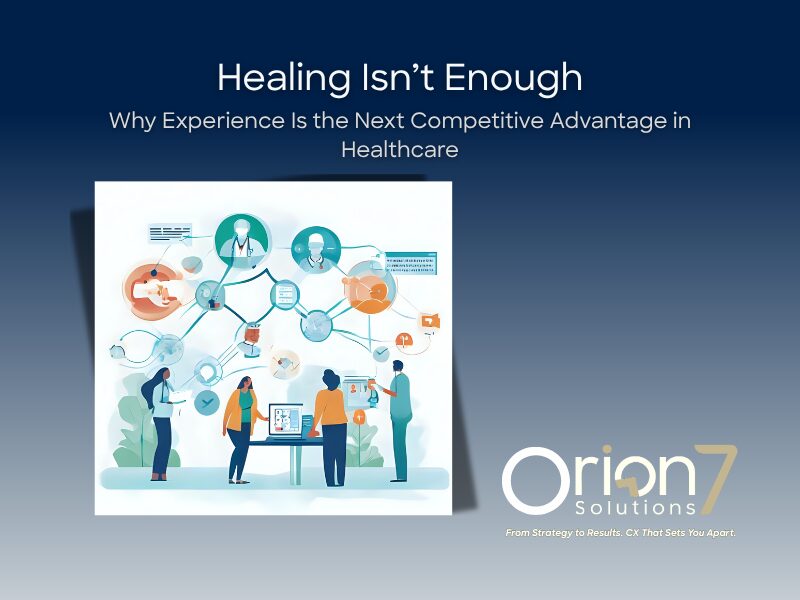
Experience Management reframes healthcare delivery as an ecosystem of emotional, logistical, and informational touchpoints. When managed intelligently, it drives measurable returns, including higher reimbursement and retention, as well as lower complaint volume and staff burnout.
A Personal Reflection on Experience Gaps
Earlier this year, my daughter faced complications during her pregnancy related to gestational diabetes. Her doctor prescribed three to five glucose tests a day, but her insurance company only approved one. It became a daily exercise in frustration.
Thankfully, her baby arrived healthy, and the medical care itself was excellent. But the experience, from prenatal through postpartum, was exhausting. If surveyed, she would probably rate her overall experience a three or four out of five.
That personal story reflects what the data shows nationwide. The average U.S. hospital rating on the HCAHPS survey has remained steady at around 73 percent for over a decade. Even as hospitals improve quality metrics and adopt advanced technology, the patient’s perception of experience has not improved.
The Systemic Reality
Healthcare is a complicated business. Every major player operates with a different agenda.
Insurance companies focus on maximizing profit by approving the least amount of care possible.
Providers work to protect their margins by managing the gap between what care costs and what they can bill.
And government agencies try to regulate and control it all, often adding complexity and cost instead of clarity and coordination.
Caught in the middle are patients and their families, who want care that is timely, coordinated, and compassionate.
It is no wonder we are seeing a rise in concierge and direct primary care models. People are not only paying for access; they are paying for experience. They want care that is proactive, personalized, and frustration-free.
Concierge healthcare is what happens when the experience becomes part of the value proposition. It may not be accessible to everyone, but it sends a clear market signal: patients will find a way to get the experience they want, even if they have to pay for it.
Of course, the growth of concierge healthcare also highlights a widening gap in the system. For many families, that level of access and personalization is simply out of reach. It is not unlike the difference between fine dining, casual dining, and fast food. Everyone is eating, but not everyone is having the same experience.
The lesson for healthcare leaders is not to replicate the concierge model, but to understand why it appeals to patients. Every provider, regardless of price point or scale, can manage communication, coordination, and empathy better. Experience equity begins with those fundamentals.
Traditional providers can take a lesson here. The opportunity is not to copy the model but to manage the experience layer of care with the same discipline they bring to clinical delivery.
Introducing Intelligent Experience Management (IXM)
The next evolution in healthcare leadership is not a new care model or reimbursement formula. It is the ability to manage the experience layer of care intelligently.
Intelligent Experience Management (IXM) is the next evolution of patient experience management. It brings together patient feedback, staff insight, and operational data to create a real-time view of how care is experienced by everyone involved. It connects clinical processes to emotional outcomes, helping leaders anticipate issues before they become complaints.
For healthcare organizations, IXM means turning data into empathy and empathy into action. It enables leaders to identify areas of friction in the patient journey, understand their root cause, and bridge the gap between how care is delivered and how it is perceived.
Technology and AI are becoming critical enablers of this evolution.
AI-powered transcription, sentiment analysis, and predictive analytics can now extract insight from call recordings, messages, and EMR notes that used to sit idle in silos. Machine learning can detect patterns in patient feedback, flag emerging risks, and even predict which experiences are most likely to affect loyalty or compliance.
Yet technology alone is not enough. The most successful healthcare organizations are learning from industries that have long managed experience as a core competency. Hospitality, retail, and financial services have mastered personalization, communication, and emotional design. When those CX principles are adapted to healthcare, the impact is transformational. Patients feel seen, staff feel supported, and organizations gain measurable efficiency and trust.
The goal is straightforward: transition from tracking satisfaction to managing experience as a measurable, repeatable discipline that combines human empathy, operational precision, and intelligent technology.
The Business Case for Patient Experience
Experience is not a soft concept. It has hard returns.
- Patients who rate their experience highly are two to three times more likely to follow treatment plans and return for future care.
- Effective patient experience management has a direct impact on retention and reimbursement. Hospitals with top-quartile HCAHPS scores see measurable improvements in reimbursement and reputation.
- Reducing operational friction saves time for both patients and staff, which directly impacts cost efficiency.
Experience Management is not just good medicine; it is sound business.
The Takeaway
Healthcare’s next competitive advantage will not come from new facilities or new technology alone. It will come from organizations that manage the care experience with the same precision they apply to the delivery of care.
Healing is essential. But in today’s healthcare environment, healing is not enough. The future of healthcare will belong to organizations that excel at patient experience management.
Call to Action
Learn how Intelligent Experience Management (IXM) can help your organization measure and manage the patient experience as a strategic asset.
📅 Book a 30-minute call to discuss how IXM can improve outcomes, retention, and revenue:
https://calendly.com/brian-orion7solutions/orion-7-introductory-meeting