
CX Strategy
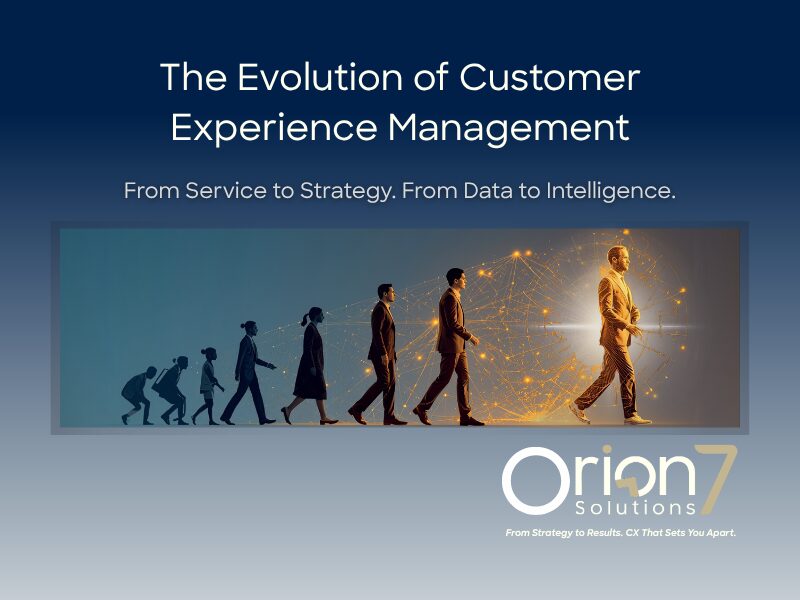

For years, Customer Experience Management (CXM) sounded like a nice-to-have function. Something that lived somewhere between marketing and service, measured through a few surveys, and presented in a PowerPoint once a quarter.
That version of CXM is over.
In 2026, customer experience isn’t a reporting line or a satisfaction metric. It’s the unifying discipline that connects people, process, and technology into tangible business outcomes. It’s how organizations learn what customers value, how to deliver it at scale, and how to translate those experiences into growth and loyalty.
At Orion 7 Solutions, we see CXM evolving from an emotional, subjective experience into something measurable and operational. The most successful companies are learning how to translate what customers feel into measurable financial results by linking emotion, effort, and loyalty directly to growth. Those that fail to make that connection will fall behind competitors who treat customer experience as essential infrastructure, not as an afterthought.
Traditional CX teams were built to react. Something went wrong; they gathered feedback, made minor improvements, and hoped satisfaction scores would climb.
But reacting isn’t managing. It’s chasing.
Most organizations still treat CX as a mix of disconnected programs. There’s a little journey mapping here, some service recovery there, and an NPS target on the side. Each function has its own tools, KPIs, and budgets. The customer doesn’t care about any of that.
In 2026, the winners will be those who stop managing fragments and start managing the entire experience system, built around proactive behavioral insights, predictive data, and operational alignment.
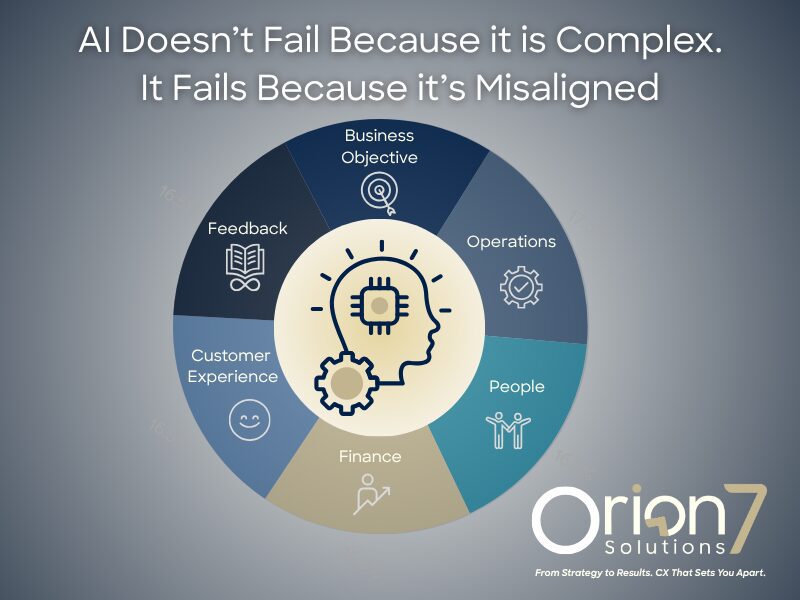
A single department doesn’t shape today’s customer experience. It’s created by every decision the company makes, from product design to billing policies to the way AI models are trained.
Customer loyalty is fragile. In many industries, a single poor experience can undo years of effort. Customers today have endless options and little patience for mistakes. That’s why CX can no longer operate on the sidelines. The margin for error has disappeared, and the last impression often decides whether the relationship continues.
That means CXM belongs in the boardroom, guiding technology decisions, resource allocation, and workforce priorities.
Think of CX as a company’s experience infrastructure: the processes, technologies, and human behaviors that determine how customers feel and what they do next.
Leaders who understand this are redesigning their organizations to remove friction before it happens, not fix it after. They connect CX strategy directly to business outcomes such as retention, revenue growth, and reduced cost-to-serve.
For decades, companies measured experience through surveys like NPS and CSAT. In 2026, those metrics are losing relevance. Customers no longer have the patience to fill out forms, and leaders no longer have the luxury of waiting for their responses.
Modern CXM is moving from asking for feedback to understanding the impact of each interaction and interpreting that impact in real time. AI can now evaluate customer satisfaction, detect frustration, identify compliance issues, and recognize which customers are true brand advocates based on conversation data, behavior patterns, and tone.
Instead of capturing opinions after the fact, the next generation of CX insight will recognize emotion and loyalty in real time.
This marks a significant shift from listening to anticipating, and from reactive data to predictive intelligence in CX insight.
The next stage of CXM is the rise of Intelligent Experience Management (IEM).
IEM blends analytics, automation, and human judgment into one adaptive system. It measures not just what happened, but why it happened and what to do next.
A contact center using IEM doesn’t just monitor handle time. It evaluates how efficiently the customer’s issue was resolved and whether the interaction strengthened the relationship.
A retail brand using IEM doesn’t wait for complaints. It detects behavioral patterns that predict churn and triggers proactive outreach before the customer walks away.
The goal is simple: create learning organizations that use every interaction to get smarter, faster, and more empathetic.
Customer service is only one chapter in the customer story. The entire journey, including marketing, onboarding, billing, and renewal, has to work as a connected system. CXM leaders now focus on building integrated ecosystems that remove silos and align goals.
Companies are moving away from asking customers how they feel and focusing instead on what their behavior already tells them. Real-time analytics, conversation intelligence, and sentiment tools are replacing those long post-interaction surveys that few people ever fill out.
Executives now want objective evidence that customer experience drives performance. The next wave of CX metrics will connect emotion and effort to tangible results such as revenue, loyalty, and retention, rather than relying on survey scores or percentages.
The contact center of 2026 is a true growth lab. Every call, chat, and email holds insight that can shape product design, marketing messages, and retention strategies. CX leaders who recognize this aren’t waiting for budget approvals anymore. They’re proving value and driving it.
The AI era has forced companies to decide whether they’re building tools or building trust. The reality is that AI is reshaping the contact center workforce. It automates repetitive tasks, reduces the number of agents needed, and lowers the total cost of ownership. At the same time, it’s raising the bar for human work. Every remaining conversation must deliver greater value, both emotionally and financially.
According to Forrester Research, experience-led business grow revenues 1.6x faster than their peers. Brands that embed CX into their core operations see higher retention, stronger employee engagement, and faster revenue growth. They reduce churn, attract talent, and build brand equity faster because everyone understands that experience is not just a function; it is the business model.
For the C-Suite, this means every executive now has a CX mandate:
When those roles work in concert, the organization performs like an orchestra with a skilled conductor. When they don’t, you get noise, inefficiency, and frustrated customers.
There’s a growing myth that AI will replace empathy. The truth is the opposite.
Technology can analyze emotion, but it can’t earn trust. It can predict frustration, but it can’t resolve it with care.
The next generation of CX leaders will use AI to augment empathy, not replace it. They’ll train systems to free humans for higher-value conversations—the ones that create loyalty and advocacy.
At Orion 7 Solutions, the future of CX is human-led, AI-enabled, and outcome-driven.
Talk is easy. Execution is what separates leaders from laggards.
Operationalizing CXM means embedding it into the company’s governance, budgeting, and performance systems. It means:
This is where many companies stall. They have vision but no system. They have metrics but no meaning. That’s the gap Orion 7 Solutions was built to close.
In 2026 and beyond, the companies that stand out will be those that treat CXM as their growth operating system, a continuous loop of insight, action, and improvement.
It’s not a campaign or a scorecard. It’s how you run the business.
CX leaders who adopt this mindset will no longer need to argue for their seat at the table. They’ll own the table.
If you’re ready to take a hard look at how your company defines, measures, and manages experience, let’s talk.
Schedule a short, no-obligation introductory call with Orion 7 Solutions to explore how Intelligent Experience Management can drive measurable results for your business.
👉 Schedule an Introductory Call
CXM isn’t a title, a team, or a trend. It’s the way modern companies earn the right to grow.
The question for 2026 isn’t whether you manage customer experience. It’s whether you’re working it intelligently, consistently, and profitably.
If you’re not, someone else will.
Author:
Brian Graves | Founder & Principal Advisor, Orion 7 Solutions
From Strategy to Results. CX That Sets You Apart.
For more insght on Customer Experience Management, visit The CX Factor blog↗.