In 2018, Zillow launched Zillow Offers, a program that used AI to predict home prices and make instant cash offers.
The goal was bold. Zillow wanted to move beyond listings and become a real estate investor, using AI to buy and resell homes for profit. The model could scan millions of listings, forecast prices, and make fast purchase decisions.
But by late 2021, the program collapsed. Zillow shut it down, laid off a quarter of its staff, and lost more than half a billion dollars.
The problem wasn’t the technology. It was alignment.
Where Zillow Went Wrong
Business misalignment: Zillow’s main business was helping people buy and sell homes, not buying them itself. The company’s AI system pushed prices higher than what made sense for its financial model, creating a gap between the tool’s decisions and the company’s risk limits.
Operational disconnect: The system also missed the small, real-world factors that drive housing markets. It didn’t weigh things like neighborhood differences, repair costs, or delays in getting materials. As a result, Zillow paid too much for many homes and struggled to sell them without taking losses.
Customer experience breakdown: Sellers received inconsistent offers. Buyers faced delays and confusing price swings. Trust disappeared.
Financial fallout: The company lost more than $500 million before ending the program.
Zillow’s CEO, Rich Barton, later said the failure wasn’t caused by bad technology. It was caused by strategic misalignment.
The AI worked. The business model didn’t.
Why Alignment Decides AI Success
Many companies are repeating the same mistake. They launch AI pilots that solve individual problems but fail to connect with business goals, operations, or customer outcomes.
AI doesn’t fail because the math is wrong. It fails because the strategy is.
Real success with AI depends on alignment. Everyone needs a shared understanding of what the technology is meant to achieve and how it supports every part of the business.
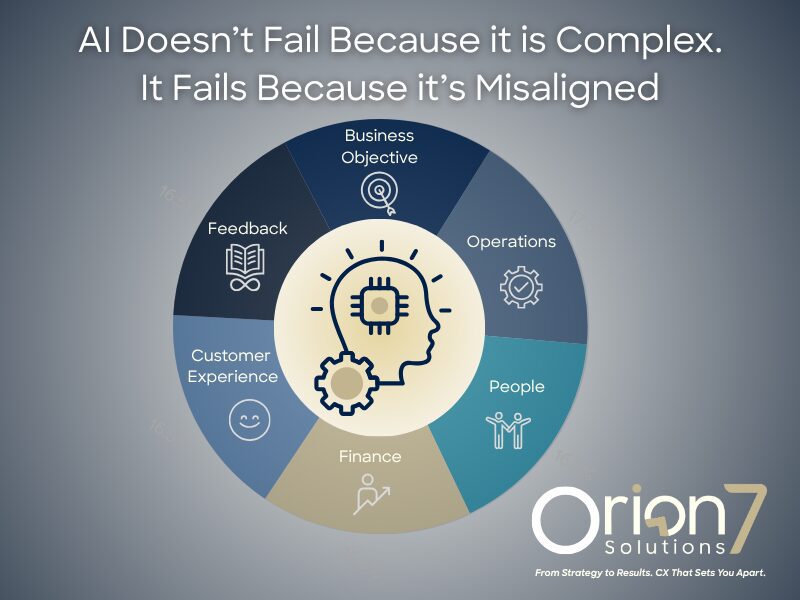
At Orion 7 Solutions, we look for alignment in five places.
1. Business Alignment: Define the “Why”
Before funding any AI project, ask a simple question: What business outcome does this support?
Too often, leaders describe features instead of results. They say, “We want AI for forecasting” or “AI for call routing.” That’s not a goal.
A goal is:
- Increase customer retention by 10 percent through predictive outreach.
- Improve forecast accuracy by 15 percent to guide staffing or inventory.
- Reduce repeat contacts by 20 percent with smarter self-service.
When the “why” is clear, everyone moves in the same direction.
2. Process Alignment: Fit AI Into the Work
AI should never sit on the side of your operation. It should live inside it.
Most pilots fail because new tools don’t fit the way teams already work. Agents, analysts, and managers end up “working around” the AI instead of with it.
Start by mapping how things happen today. Look at where data flows, who makes decisions, and where friction slows the process. Then design AI to reduce that friction.
If a process is broken now, AI will only automate the chaos later.
Process alignment means every workflow, role, and metric connects back to how AI helps achieve the company’s goals.
3. Customer Alignment: Improve Experience, Not Just Efficiency
AI should make customers’ lives easier. When it doesn’t, adoption drops fast.
Disconnected AI systems can break the journey. Chatbots give wrong answers. Handoffs fail. Customers repeat themselves.
Customer alignment starts with empathy. Every AI decision should ask, Does this make it easier for the customer to get what they need?
When CX leaders help shape AI projects from day one, technology strengthens trust instead of testing it.
4. Financial Alignment: Link Results to the P&L
AI must make financial sense.
That doesn’t mean cutting costs at any price. It means connecting AI results directly to revenue or savings.
If AI speeds up issue resolution, what’s the dollar value of that time saved? If it reduces churn, what’s the lifetime revenue impact?
Financial alignment turns AI from an expense into an investment. It gives the CFO, COO, and CXO shared visibility into performance and return.
When Finance is part of the design, AI becomes a value engine, not just a technology experiment.
5. Feedback Loop: Measure, Learn, Realign
AI doesn’t stay aligned on its own.
As markets, data, and customer needs evolve, even the best-designed systems can drift.
That’s why every AI initiative needs a feedback loop — a way to measure performance, learn from outcomes, and adjust course.
Use operational data, customer sentiment, and financial metrics to confirm that AI is still supporting your original goals.
When results are reviewed regularly and shared across teams, alignment stops being a one-time project and becomes a living system that gets smarter over time.
The Leadership Factor
Alignment is not a project plan. It’s a leadership discipline.
Companies that succeed with AI treat it as a business strategy, not an IT initiative. They build cross-functional AI councils, set shared metrics, and review outcomes together.
Everyone owns the result, not just the tool.
When leaders align early, AI becomes a force multiplier. When they don’t, even good technology can sink the business.
The CX Factor Takeaway
Zillow’s story is a warning, but it’s also a lesson.
AI can do amazing things. But if it isn’t aligned with your goals, your customers, and your financial reality, it can just as easily destroy value.
Before your next AI investment, ask yourself five questions:
- Does this project tie directly to a measurable business goal?
- Does it fit our current processes?
- Will it improve customer experience in a clear way?
- Can we show its impact on revenue or cost?
- Do all leaders share the exact definition of success?
If you can’t answer “yes” to all five, pause before you proceed. Alignment is the difference between scaling and stumbling.
Ready to Test Your Alignment?
Most leaders don’t need another AI vendor. They need a strategy that connects technology to business outcomes.
Start with the CX AI IQA — a short, guided assessment that benchmarks how ready your company really is to align AI with measurable business results.
Take the CX AI IQA now.
And if you want a fast, practical conversation about where your company stands, schedule a 15-minute AI Strategy Call at calendly.com/brian-orion7solutions/ai-readiness-call.
Because AI doesn’t create alignment.
Leadership does.
Related reading: Why 95% of AI Pilots Fail and How to Succeed | The Hidden Cost of AI Implementation